

I used to treat class notes like a storage unit. I would write everything down, close the notebook, and tell myself I would “review later.” Later, of course, meant the night before a quiz, staring at pages of passive highlights and hoping something would stick.
The Cornell Note-Taking System was the first method that made my notes do something. Not just capture information, but prompt recall, guide daily review, and show me what I actually understood. The power is not the page layout by itself. It is how that layout turns into a tiny built-in study session you can repeat every day.
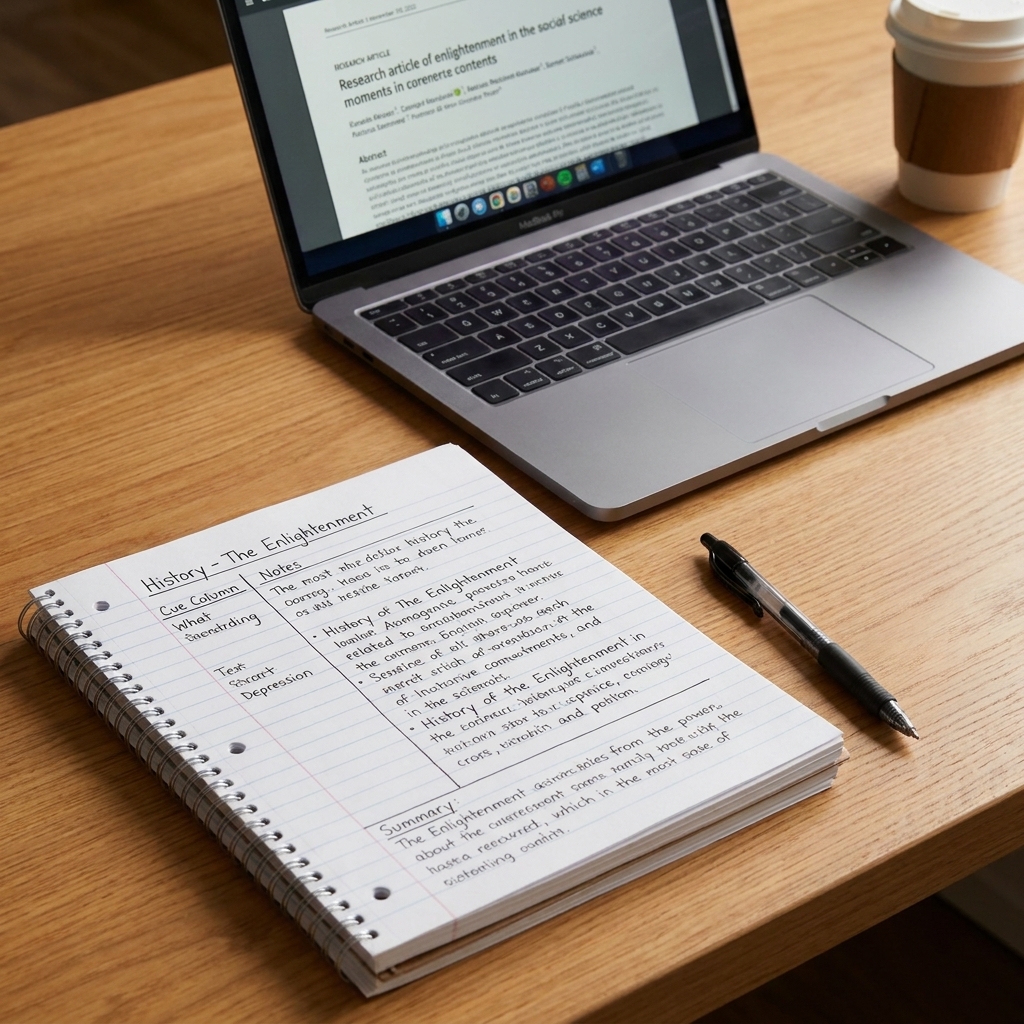
What Cornell notes are for
Cornell notes get described as a note-taking format, but I think of them as a daily review system disguised as a page. The page nudges you to do three active things:
- Collect notes during class or reading.
- Convert those notes into questions and cues soon after.
- Recall answers later without looking, then check yourself.
If you only do the first part, you will still end up with passive notes. The routine is where the system becomes powerful.
The Cornell page setup
A classic Cornell page has three sections (and often a simple header at the top for course, date, and topic):
- Notes column (right, widest area): where your main notes go.
- Cue column (left, narrower area): keywords and, more importantly, questions that help you test yourself.
- Summary (bottom): a short explanation in your own words that stitches the page together.
If you like specifics, here is a clean starting point:
- Cue column: about 1/3 of the page width.
- Notes column: about 2/3 of the page width.
- Summary box: the bottom 2 to 3 inches (or about 5 to 8 cm).
You can do this on paper, in a tablet note app, or in a document. The key is that the cue column must be easy to cover so you can quiz yourself from it.

The daily routine in 10 minutes
This is the workflow I recommend if you want Cornell notes to become a daily tool instead of a pretty format. Think of it as two mini sessions: one right after class and one later in the day.
Step 1: 3-minute cleanup (same day)
Before you do anything fancy, make the notes column usable:
- Fix incomplete sentences or missing definitions.
- Add a quick example if the teacher gave one.
- Circle anything you did not understand yet.
This step prevents your review from turning into decoding your own handwriting.
Step 2: 4-minute cue conversion
Now turn the notes into prompts. In the left cue column, write:
- 1 to 3 keywords that label the chunk of notes.
- At least 2 cue questions that force retrieval, not recognition.
Better cue questions sound like:
- “Why does X happen?”
- “What is the difference between A and B?”
- “When would you use this formula?”
- “What are the steps, in order?”
Weaker cue questions are basically prompts to reread, like “Definition of X.” If you write that, push it one step further: “Define X and give one real example.”
Step 3: 2-minute summary
Your summary is not a recap of every detail. It is a short, personal explanation of what the page is about and how the ideas connect. Aim for 2 to 4 sentences:
- What is the main concept?
- What causes what?
- What would you need to remember for a test problem?
Step 4: 1-minute quick recall (later that day)
Come back once more the same day. Cover the notes column with your hand or another sheet and use the cue column to quiz yourself. You are aiming for imperfect retrieval, meaning you try to answer before you feel fully ready, then you tighten it up.
If you get stuck, peek, then try again immediately. That immediate second attempt is where retrieval practice pays off.
A filled-in example
Here is what one Cornell page might look like when it is working well. Imagine the topic is photosynthesis.
Header: Biology | 10/12 | Photosynthesis overview
Cue questions (left):
- What is photosynthesis, in one sentence?
- Where do the light-dependent reactions happen, and what do they produce?
- How is the Calvin cycle different, and what does it need to run?
Notes (right):
- Photosynthesis converts light energy into chemical energy stored in glucose.
- Light-dependent reactions occur in thylakoid membranes. They use light + H2O to produce ATP, NADPH, and O2 (released).
- Calvin cycle occurs in the stroma. It uses ATP + NADPH to fix CO2 into sugars (requires enzymes, including RuBisCO).
Summary (bottom, 2 to 4 sentences): Photosynthesis has two linked stages. The light-dependent reactions capture light energy to make ATP and NADPH and release oxygen. The Calvin cycle uses that ATP and NADPH to build sugars from carbon dioxide, which is why the two stages depend on each other.
Notice what is happening: the cue questions create a mini quiz, the notes are written to answer that quiz, and the summary proves you can connect the parts.
Cue questions that work
If you want Cornell notes to power a daily review routine, your cue questions have to do more than label. Here are my go-to cue question types, with examples you can copy.
Explain it clearly
- “Explain X in your own words.”
- “Teach X to someone who missed class.”
If you like that style of learning, you will probably also enjoy the Feynman Technique breakdown, which pairs beautifully with Cornell cue columns.
Compare and separate
- “How is A different from B?”
- “What is a common confusion between A and B?”
Steps and sequences
- “List the steps in order.”
- “Where do people usually mess this up?”
Cause and effect
- “What causes X?”
- “If X changes, what happens to Y?”
Examples and non-examples
- “Give a real example of X.”
- “What would NOT be an example of X?”
Pair Cornell with spaced repetition
The daily review is your baseline. Then, to keep the information alive, add two quick revisit points:
- Day 2: 5 minutes. Cover the notes column and answer the cue questions again.
- Day 7: 5 to 10 minutes. Repeat, and star any cue questions you still miss.
If you want a learning-style-friendly way to schedule those revisits, see Spaced Repetition by Learning Style. The goal is the same, but the delivery can feel very different depending on what you find most usable day to day.
Adjust it to your preferences
One-size-fits-all note advice is how a lot of us end up burnt out and convinced we are “bad at studying.” You are not bad at studying. You are probably using a method that does not fit your preferences or your life right now.
Visual preference
- Use consistent symbols in the notes column (stars for testable ideas, triangles for confusing points).
- Add a small sketch or visual anchor next to the chunk of notes, then write cue questions that reference it.
- Consider building a weekly plan that leaves room for short review blocks. This color-coded schedule approach can make reviews feel more seeable.
Auditory preference
- Read cue questions out loud and answer out loud.
- Record a 60-second voice note summary after you write the bottom summary.
- If you review on the move, adapt the cue column into a commuting-friendly script. The rhythm in The Commuter’s Study Plan for Auditory Learners works well with Cornell questions.
Read/write preference
- Make your cue column text-heavy: definitions in your own words, short prompts, and mini outlines.
- Use the summary box to rewrite the concept more cleanly than your in-class notes.
- If your notes tend to sprawl, you might like From Messy Notes to Mastery for tightening up your process.
Hands-on preference
- Stand up for the quick recall and pace while answering.
- Convert cue questions into actions: “Sort these terms into two categories,” then physically move sticky notes.
- Use short timed sessions so review feels active, not endless. Pomodoro by Learning Style can help you choose an interval that fits your attention.
Use Cornell on old notes
If you have weeks of traditional notes, you can still switch without rewriting everything.
The retro-Cornell method (15 minutes)
- Pick 1 to 2 pages of old notes only. Do not try to fix the whole semester.
- On a fresh Cornell page, write 5 to 8 cue questions on the left.
- In the notes column, write only the answers to those questions, using your original notes as reference.
- Add a summary that explains the big idea.
- Quiz yourself once immediately.
This turns your backlog into something testable, not just readable.
Common problems and fixes
“I do not have time after every class.”
Do a “minimum viable Cornell” pass:
- Write two cue questions only.
- Write a one-sentence summary.
- Circle one confusing spot to ask about later.
Consistency beats completeness.
“My classes move too fast.”
Take messy notes first. Then convert them into Cornell within 24 hours. Cornell is a review system, not a performance during lecture.
“My cue questions feel obvious.”
Upgrade them by adding one of these endings:
- “…and why?”
- “…and give an example.”
- “…and when would you use it?”
“I keep rereading instead of recalling.”
Make it harder to cheat. Fold the page, cover the notes column, or use another sheet. If you need structure, build a repeatable routine with a study session you can check off so recall becomes the default action.
A simple schedule
If you want Cornell to run quietly in the background of your life, anchor it to something you already do.
- Right after class (or right after reading): 7 to 10 minutes to add cue questions and a summary.
- After dinner or before bed: 3 to 5 minutes of quick recall from the cue column.
- Twice a week: 20 minutes to revisit starred cue questions across multiple pages.
That is it. No marathon review sessions required.

When Cornell is not enough
Cornell cue questions are fantastic for definitions, processes, and concepts. If you are studying something that requires heavy practice, like math problems, coding exercises, or chemistry calculations, treat Cornell as your understanding layer and add a practice layer:
- Keep cue questions like: “What is the first step in solving this type?”
- In the notes column, include one worked example.
- Then do 3 to 5 extra practice problems separately.
If your week gets overwhelming, it helps to plan those layers intentionally. This multimodal study week guide shows how to mix reading, recall, and practice without cramming everything into one night.
Your notes can be unfinished
The goal is not to create perfect Cornell pages. The goal is to create pages you can use every day. If you write two cue questions and do a three-minute recall tonight, you are already studying actively, and your future self will feel the difference.
If you want to sanity-check whether your current approach is fighting you, not helping you, these signs your study plan clashes with your learning style can be a gentle starting point.