

I used to blame my “lack of discipline” every time a study plan fell apart. The truth was less dramatic and way more helpful. A lot of my routines were built for someone else’s brain.
If your plan looks great on paper but feels like pushing a boulder uphill in real life, it may not be a motivation problem. It might be friction between your plan and how you actually learn day to day. Below are seven signs your current study plan clashes with your learning preferences, plus simple ways to pivot without burning everything down.

First, a quick note on “learning styles”
When I say learning style, I mean your practical learning preferences. The ways you tend to take in, organize, and rehearse information most comfortably.
It is also fair to say the research world debates strict “you are one type forever” learning styles, and the strongest evidence supports strategies like retrieval practice, spacing, practice testing, and feedback. What I have found helps most people is combining those proven strategies with formats that feel easier to start and easier to stick with. If you want a fuller overview, start with our guide to learning styles.
Sign #1: You reread a lot, but very little sticks
What it looks like: You spend hours rereading chapters or notes. You recognize the sentences, but when you close the book you cannot explain the ideas in your own words.
Why it can be a poor fit: Rereading is passive. If you learn best by talking it out or doing something with the information, your brain may need retrieval, movement, or structure to lock it in.
Try this pivot
- Switch one reread session into retrieval practice. Close the material and write 5 to 10 questions you think you will be tested on, then answer from memory.
- Use a “teach it out loud” pass. Explain the topic to an empty room in plain language for 3 minutes, then check what you missed.
- Keep rereading, but cap it. Give yourself one quick skim for context, then move on to active work.
If you want a structured way to do this, I walk through a repeatable process in Build a Study Session You Can Check.
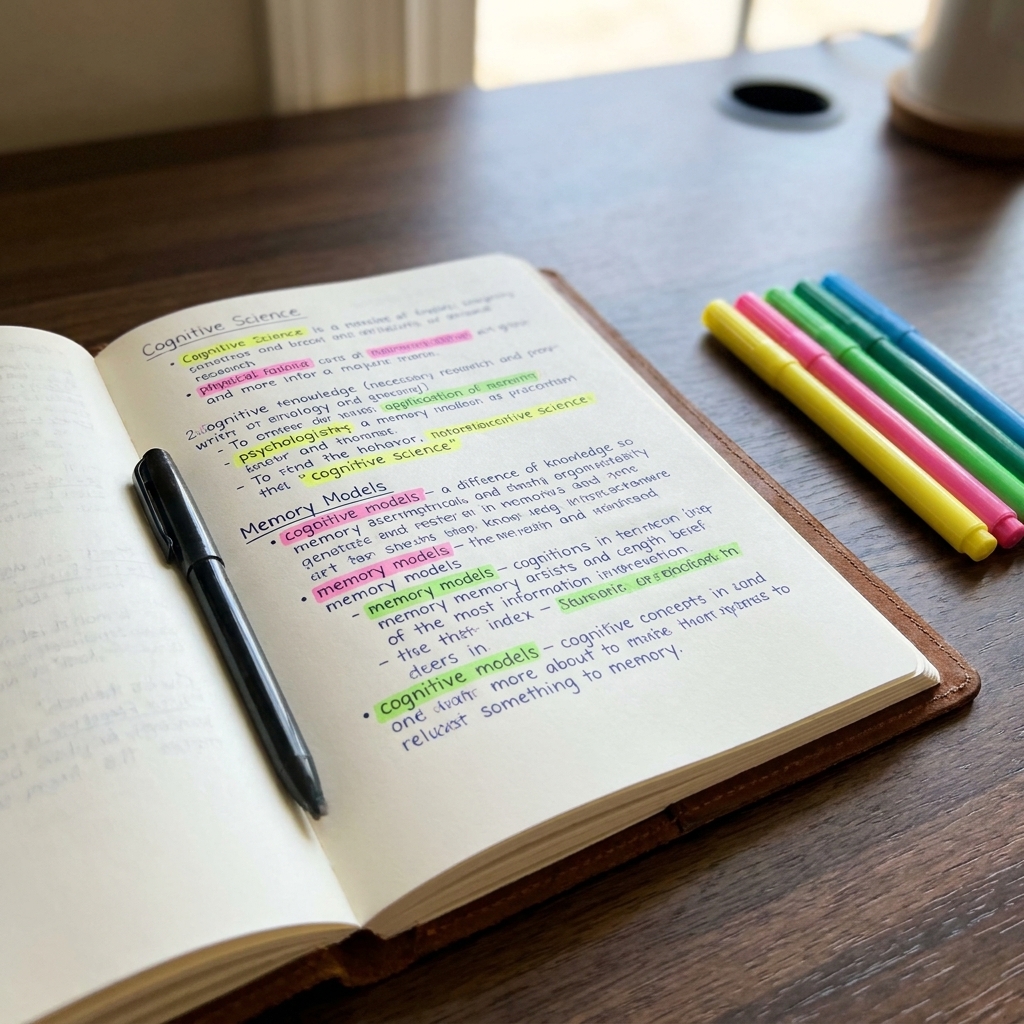
Sign #2: Your notes are pretty, but not useful
What it looks like: You love highlighting, rewriting, and organizing notes. They look gorgeous. Then exam week hits and you still feel lost.
Why it can be a poor fit: For many visual learners, color and layout help, but only if the notes are built for recall. For many verbal learners, rewriting notes is busywork unless it turns into questions, summaries, or explanations.
Try this pivot
- Convert notes into prompts. In the margin, write “Why?” “How does this connect?” “Example?” and answer those during review.
- Use a one-page map. After a lecture, compress the topic into a one-page overview with headings and arrows. If you cannot fit the main ideas and how they connect, that is a sign you need another pass.
- Color-code with purpose. One color for definitions, one for examples, one for common mistakes.
Visual structure can be powerful when it is consistent. See Color-Coded Study Schedule for Visual Learners for ideas that translate well into note review.
Sign #3: You dread starting because the plan feels rigid
What it looks like: Your schedule is precise, but missing one block makes you feel like the whole day is ruined. You procrastinate because the plan feels like a trap, not support.
Why it can be a misalignment: Some learners thrive with tight structure. Others need flexibility and momentum first. If your brain is more warm-up first, then focus, an overly rigid plan can create avoidance.
Try this pivot
- Replace one long block with a minimum viable session. Commit to 10 minutes. If you continue, great. If not, you still kept the habit.
- Use a 2-list day. One must-do list (1 to 3 items) and one bonus list (everything else).
- Plan in ranges, not minutes. Example: “Read and self-quiz sometime between 4 and 6.”
This is still time management, just friendlier. More ideas live in our study skills guide.
Sign #4: You are busy, but not improving
What it looks like: You are putting in time consistently. Your checklist is full. Yet your practice test scores or assignment quality barely move.
Why it can be a poor fit: A plan can be efficient and still target the wrong behavior. Many of us default to what feels productive, not what produces learning. If you tend to jump into doing, you might need more reflection and correction. If you tend to plan and organize, you might need more reps and feedback.
Try this pivot
- Track outcomes, not hours. After each session, write: “What can I do now that I could not do before?” For example: “I can solve 8 out of 10 integration problems without notes” or “I can explain the three causes of the French Revolution in 60 seconds.”
- Add a weekly feedback loop. Once a week, do one timed mini-test or problem set and let the results steer the next week.
- Match practice to the exam. If the exam is problem-solving, your plan must include problem-solving, not just reading about it.
Sign #5: You feel mentally fried fast
What it looks like: You sit down to study and your brain taps out quickly. You are not being lazy. You are wiped.
Why it can be a misalignment: Your plan may ignore your attention patterns. Some people do well with long deep-focus blocks. Others need frequent resets, movement, or variety to stay engaged.
Try this pivot
- Shorten cycles. Try 25 minutes focus, 5 minutes break, repeated 3 times, then take a longer break.
- Change the mode, not the topic. Same chapter, different approach: read, then sketch a quick concept map, then self-quiz.
- Add a physical reset. Stand up, refill water, stretch, or walk for two minutes between blocks.
If you struggle with pacing and stamina, you will find supportive options in our learning styles guide and study skills guide.

Sign #6: You keep switching methods
What it looks like: One week it is flashcards, then mind maps, then a new app, then a new planner layout. You are trying hard, but you never stay with one system long enough to benefit.
Why it can be a poor fit: Sometimes this is distraction, but often it is a signal that the method does not fit your preferences or your actual life constraints. The answer is not endless novelty. It is a small, stable core routine with optional add-ons.
Try this pivot
- Pick a core 3. Choose three tools only: one for input (notes), one for practice (questions or problems), one for scheduling.
- Run a 7-day experiment. Keep everything else constant and test one change at a time, like “add 10 minutes of self-quizzing.”
- Write a stop-doing list. Drop the study behaviors that look impressive but do not move your results.
Sign #7: You avoid the environment your plan requires
What it looks like: Your plan assumes you will study in silence at a desk for two hours. But you keep “failing” to show up. Or you sit there and cannot focus.
Why it can be a poor fit: Your environment is part of your learning conditions. Some people need quiet. Others need gentle background noise, a change of scenery, or the ability to move.
Try this pivot
- Build two environments. A deep-focus setup (quiet, minimal clutter) and a light-focus setup (cafe, library common area, or home with background sound).
- Use location as a cue. One spot for reading, another spot for practice questions. Your brain learns the pattern.
- Make the first five minutes easier. Open notebook, write the first prompt, set a timer. Starting is the hardest part.
Realign your plan in 20 minutes
If you are thinking, “Okay Naomi, but what do I do today,” here is my quick reset.
Step 1: Pick the biggest pain point
Choose one sign from this list that causes the most stress or wasted time. Just one. We are not rebuilding your entire system at once.
Step 2: Match it to a strength
These are common preference clusters, not fixed labels. Pick the one that feels most true today, then borrow the strategies that help you follow through.
- If you learn by seeing: compress into one-page maps, consistent color categories, and visual cues.
- If you learn by hearing or explaining: teach-back out loud, record short voice summaries, study with a partner for Q&A.
- If you learn by doing: practice problems early, make mini projects, use active recall with real prompts.
- If you learn by structure: clear checklists, predictable time blocks, fewer tools.
- If you learn by variety: rotate modes in the same session and keep blocks shorter.
Step 3: Change one variable for one week
Change one thing, then observe. Your goal is not perfection. Your goal is evidence.
Step 4: Keep what works
At the end of the week, write two sentences:
- “This helped because…”
- “Next week I will adjust…”
If you want a simple structure you can repeat, start with Build a Study Session You Can Check. It is my go-to when my motivation is fine but my plan is not.
Common questions
What if I do not know my learning style?
Start with what you avoid. Do you avoid rereading, sitting still, timed practice, group study, writing summaries, or quiet environments? Avoidance is often a clue. Then read our learning styles guide and test one change for a week.
Can I have more than one learning style?
Absolutely. Most of us are mixed. Your best plan usually blends two or three approaches, with one anchor method you can rely on when life gets busy.
Is it normal to need different methods for different subjects?
Yes. Math-heavy courses often reward practice and feedback. Reading-heavy courses often reward retrieval, summaries, and connections across themes. A plan that works for biology might feel terrible for literature and that does not mean you are doing it wrong.
A gentle reminder
If your current plan feels like a fight, it is not proof you are bad at studying. It is information. You are learning how you learn, and which evidence-based habits help you actually remember.
One more thing: if exhaustion, anxiety, or focus issues feel persistent and are getting in the way of daily life, it can help to talk with a teacher, academic support services, or a health professional. You do not have to brute-force your way through that alone.
When your routine fits your preferences and includes proven strategies like retrieval and feedback, studying can stop feeling like constant self-control and start feeling like a system you can actually live with.
If you want to learn more about the approach behind this article, you can also read about me here: Naomi Prescott.