

I used to plan my study week like a productivity buffet: a little mind map here, a podcast there, some flashcards at midnight, and somehow I still felt behind. The problem was not that I was using “too many” learning methods. It was that I was switching methods without a structure, so every day felt like starting over.
If you like variety (visual, auditory, and hands-on methods), a multimodal week can be incredibly effective. It can also turn into a noisy mess if you try to do everything, every day. Below is the way I build a multimodal study week that stays varied without becoming overwhelming.
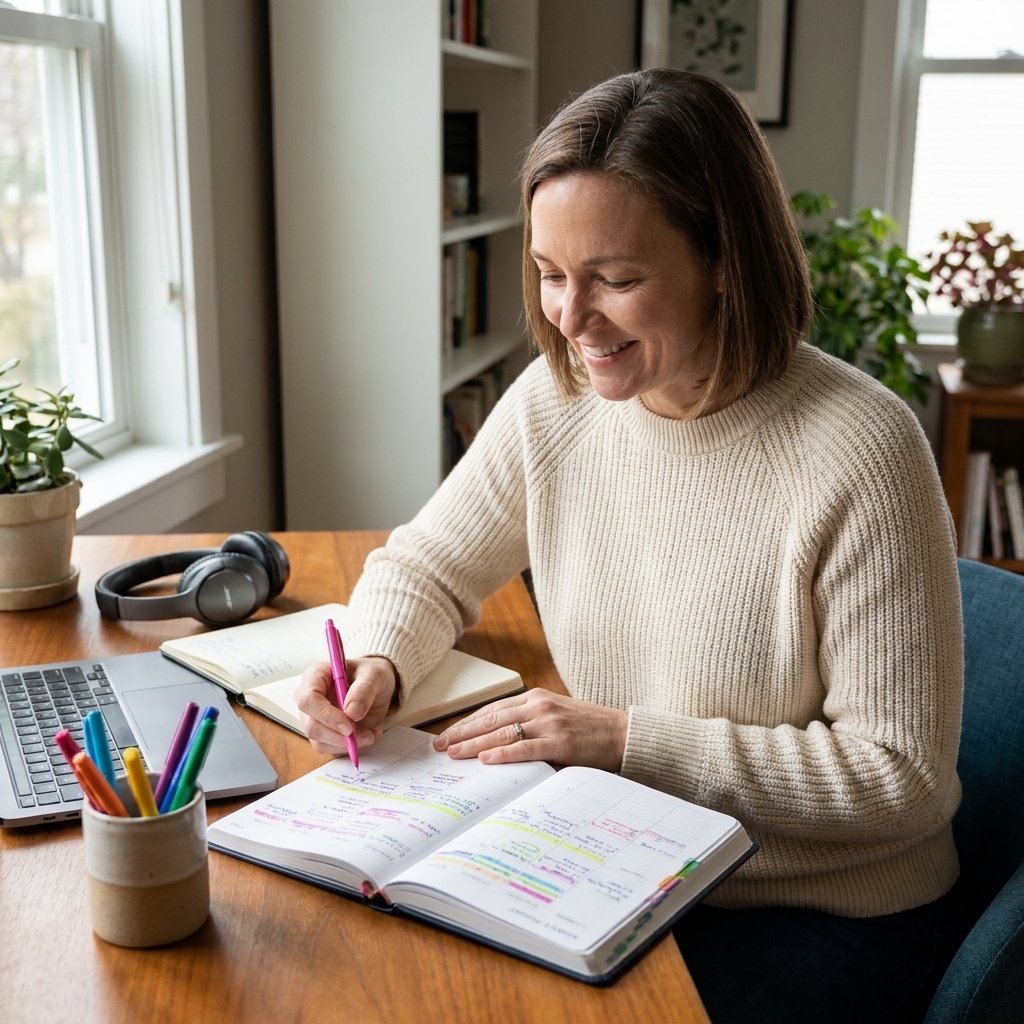
Start with a weekly structure
Multimodal study works best when your week has a repeating rhythm. Your daily plan can stay simple because you already know what kind of work each day is for.
Here is the foundation I recommend:
- 2 days to take in new material (input heavy)
- 2 days to practice and retrieve (output heavy)
- 1 day to integrate and review (connections and mixed practice)
- 1 flexible catch-up day (short, low-pressure)
- 1 real rest day (yes, it counts)
This structure matters because different approaches map naturally to different phases. Visual and auditory methods often help with input. Hands-on (tactile or kinesthetic) methods shine during practice. Integration is where you combine them on purpose.
If you want a quick refresher on how modalities are commonly described, see my overview in Learning Styles.
Pick an anchor for each subject
When everything is multimodal, it is easy to overbuild your plan. Instead, assign each subject an anchor, meaning the one approach you default to when you are tired, busy, or unsure what to do next.
How to choose an anchor
- Visual anchor: you understand faster when you can see relationships. Great for history timelines, biology processes, economics graphs.
- Auditory anchor: you grasp ideas when you can talk them through or hear them explained. Great for languages, literature themes, lecture-heavy courses.
- Hands-on anchor (tactile or kinesthetic): you learn by doing and correcting. Great for math problem sets, coding, chemistry practice, anything procedural.
You will still use the other approaches. The anchor just prevents decision fatigue. On rough days, you do the anchor and move on.
One important note: the research on fixed “learning styles” is mixed. I treat modalities as tools, not labels. The goal is not to prove you are a “visual learner.” It is to pick methods that fit the task and keep you consistent.
Use a simple rotation rule
This rule is my biggest overwhelm-prevention tool:
- Main method (70 percent): the approach doing the heavy lifting
- Supporting method (30 percent): a second approach that reinforces without taking over
Example: If your main method is hands-on practice (problem sets), your supporting method could be visual (error log with color coding) or auditory (explain your solution out loud).
Why this works
You can get the benefits of combining formats, like making information both verbal and visual, and keeping practice varied, without juggling three tools and five tabs per session.
A sample multimodal week
Below is a sample week. You can copy the pattern even if your available days are different.
| Day | Theme | Main modality | Supporting modality | What you actually do |
|---|---|---|---|---|
| Mon | Learn new content | Visual | Auditory | Skim lesson, create a one-page map, then listen to a short explanation while tidying notes |
| Tue | Practice | Hands-on | Visual | Problem set or exercises, plus an error log and quick “why I missed it” highlights |
| Wed | Learn new content | Auditory | Visual | Watch or listen to a lecture recording at 1.25x, then draw a simple flow of the key idea |
| Thu | Practice and retrieve | Hands-on | Auditory | Timed practice, then teach-back: explain 3 tricky questions out loud |
| Fri | Integrate | Mixed | Mixed | Mini mock quiz, then build one condensed summary sheet from what you missed |
| Sat | Catch-up (light) | Anchor only | None | Finish leftovers, reset notes, prep next week’s materials, stop early |
| Sun | Rest | None | None | Full break or gentle planning only |
Notice what is missing: there is no day where you must mind map, flashcard, record yourself, rewrite notes, and do a practice test. That is not a plan. That is a pile of activities.

If you have fewer days
If your week is not a neat seven-day canvas, you can still use the rhythm. You just compress it.
- If you only have 4 study days: do input plus a short retrieval check on two days, practice plus corrections on two days, then add a 15 minute integration quiz at the end of your last session.
- If you have 3 study days: make Day 1 input, Day 2 practice, Day 3 mixed review. Keep the “one main plus one support” rule and you still get variety without chaos.
- If you work shifts: label sessions by theme instead of day name: Input, Practice, Practice, Integrate, Catch-up. Run the next theme whenever you have time.
Build each study block
If your week is the macro structure, your study block is the micro structure. I like a three-part block that works with any modality.
1) Warm start (5 minutes)
- Write the one outcome: “By the end, I can solve 10 chain rule problems” or “I can explain the causes of World War I from memory.”
- Pick today’s main method and supporting method.
2) Deep work (25 to 45 minutes)
Choose one:
- Visual deep work: concept map, timeline, process sketch, annotated reading
- Auditory deep work: listen and outline, discuss with a classmate, record a short teach-back
- Hands-on deep work: practice problems, lab-style steps, coding exercises, written recall
If you like Pomodoro, keep it boring and consistent. The consistency is the point. If you need help building a repeatable session you can reuse, I walk through it step-by-step in Build a Study Session You Can Check.
3) Close the loop (5 to 10 minutes)
- Write 3 bullets: what clicked, what did not, what is next.
- Create one tiny “future you” asset: a single flashcard, one summary box, or one error-log entry.
Match method to the job
When you like variety, it is tempting to pick the method that feels nicest. I do it too. But your week gets easier when you match method to task.
Best uses for visual methods
- Seeing relationships: cause and effect, sequences, systems
- Compressing information into a single page
- Spotting gaps in your understanding quickly
Best uses for auditory methods
- Getting unstuck when reading feels slow
- Building verbal recall for essays, interviews, languages
- Strengthening understanding through teach-back and discussion
Best uses for hands-on methods
- Making knowledge usable: procedures, calculations, applications
- Retrieval practice: testing yourself and correcting mistakes
- Reducing overconfidence from “I recognize it” to “I can do it”
If you feel overwhelmed, ask: What is the job today? Then choose the method that does that job best.
Avoid common overwhelm traps
Trap 1: Pretty materials instead of learning
Visual tools are powerful, but they can become arts and crafts. Give yourself a limit: one page, two colors, 15 minutes. The goal is clarity, not decoration.
Trap 2: Passive audio that feels productive
Audio is great, but only if you attach an action. Try “listen, then speak” or “listen, then write 5 recall questions.”
Trap 3: Switching tools mid-session
Tool switching burns time and attention. Decide your main and supporting method before you start, then stay with it for the block.
Trap 4: No recovery space
A multimodal plan needs whitespace. Protect a lighter catch-up day and a real rest day. Most people find they remember and connect ideas better when they give themselves downtime.
Trap 5: Studying by topic only
If your exam requires solving, your week needs solving. If your goal is writing, your week needs writing. Plan around the output you will be graded on.
A minimum viable week
When life gets loud, your study week should shrink, not shatter. Here is a minimum viable version that still keeps the multimodal feel:
- Day A (input): 30 to 45 minutes visual or auditory, plus 5 minutes of recall notes
- Day B (practice): 30 to 45 minutes hands-on practice, plus 5 minutes error log
- Day C (review): 20 minutes mixed quiz and corrections
Repeat A and B as needed. Keep C once per week. This is the plan I use when I am juggling work and deadlines, and it is surprisingly effective because it stays focused.

Two small knobs to adjust
Instead of rebuilding your whole schedule, adjust these two knobs first.
Knob 1: Intensity
- Low intensity: listen and outline, simple sketch notes, short practice set
- High intensity: full retrieval quiz, timed problems, teach-back without notes
If you are tired, lower intensity, not consistency.
Knob 2: Session length
- Short blocks: 20 to 30 minutes for momentum days
- Medium blocks: 45 to 60 minutes for practice days
- Long blocks: 75 to 90 minutes only when you have a clear plan and breaks
Long sessions are not automatically better. For multimodal learners, shorter sessions with a clear method often win because you spend less energy ramping up.
How to track progress
If you want your plan to feel less emotional week to week, track a few outputs. You do not need a spreadsheet. A note in the margin works.
- Retrieval score: percent correct on a short quiz you make for yourself (even 5 questions)
- Repeat mistakes: how many errors show up again in your error log
- Time to recall: how long it takes to explain a concept without notes (faster is usually a good sign)
If your effort is high but these numbers are stuck, shift time toward hands-on retrieval and corrections and away from passive input.
FAQ
Do I need all three modalities every day?
No. In fact, I recommend you do not. Use one main method and one supporting method per session. Save full mixing for your integration day.
What if one subject needs multiple modalities?
Give it an anchor anyway, then schedule the second as support. Example: for anatomy, you might anchor visually (structures and spatial relationships) and support hands-on (labeling practice and recall quizzes).
How do I know if my week is working?
Check your outputs, not your effort. Are you recalling without notes more easily? Are practice scores improving? Are you making fewer repeated mistakes? If yes, keep the structure. If not, add more retrieval and correction time and reduce passive input.
I feel guilty resting. How do I make rest feel like part of studying?
I reframe it as consolidation time. If you want something study-adjacent, keep it tiny: 10 minutes to plan the week or tidy your materials, then stop. Your long-term consistency matters more than squeezing in one more hour.
When in doubt, simplify
A multimodal study week is not a requirement to do more. It is a way to do the right kind of work at the right time, with fewer decision points.
If you want a gentle next step, pick one subject and try this for seven days: two input days, two practice days, one integration day, one catch-up day, one rest day. Keep the rule of one main method and one supporting method. Then adjust from what you notice, not from what you think you “should” be able to do.
For more ways to keep your routines flexible without burning out, browse the Study Skills guide.