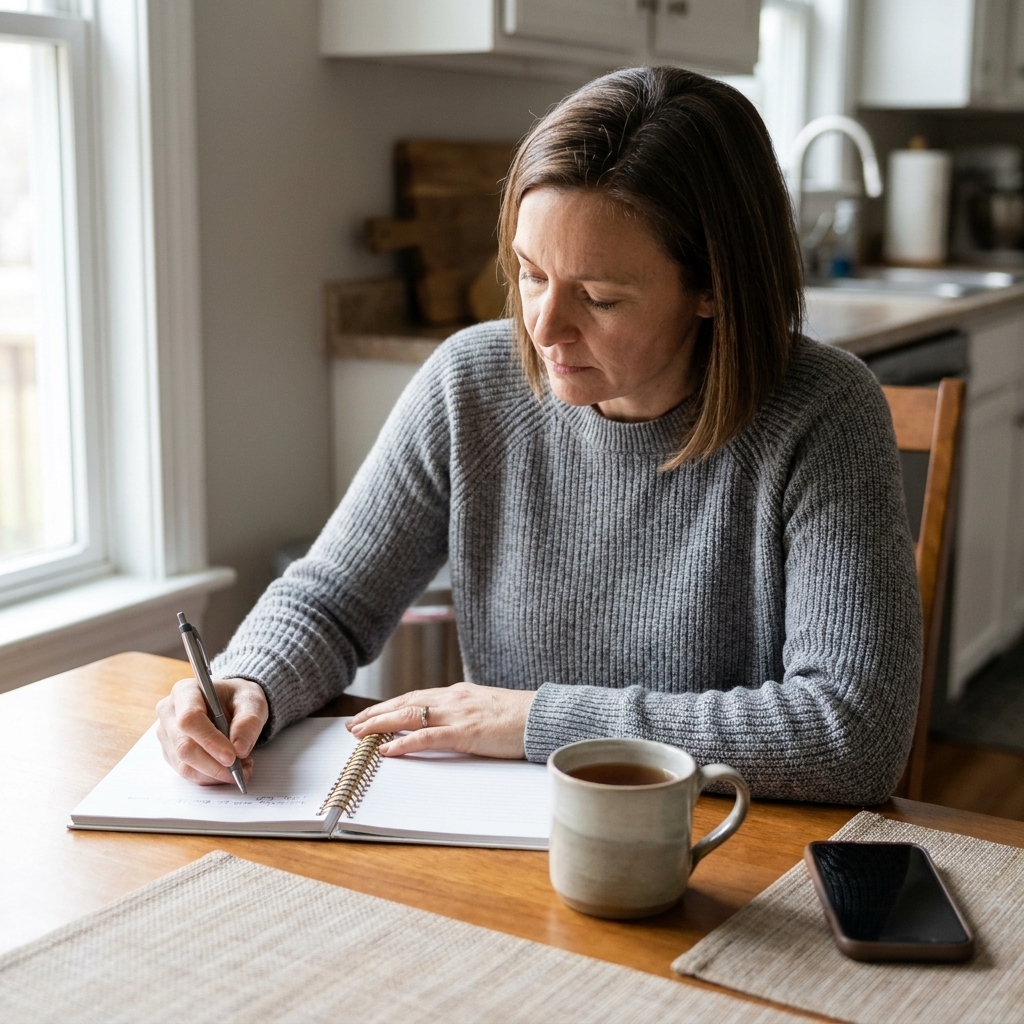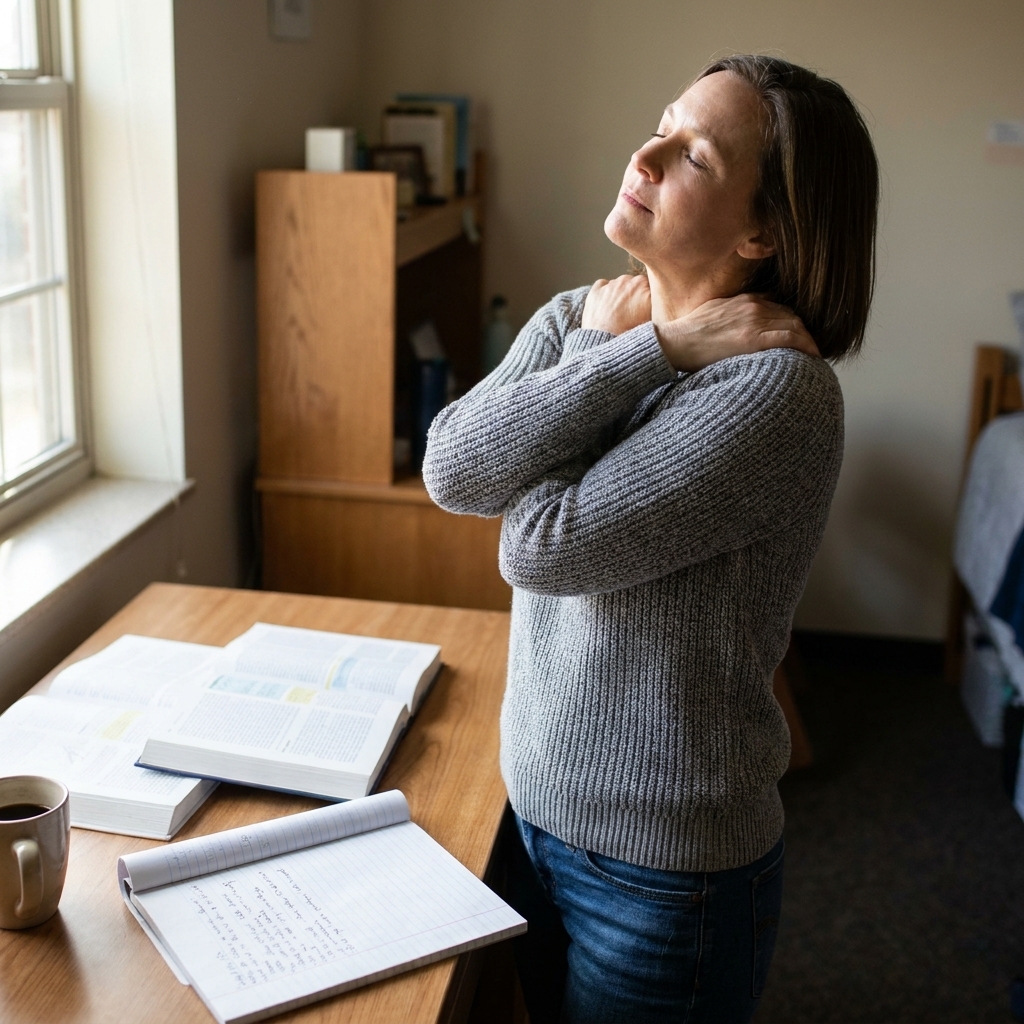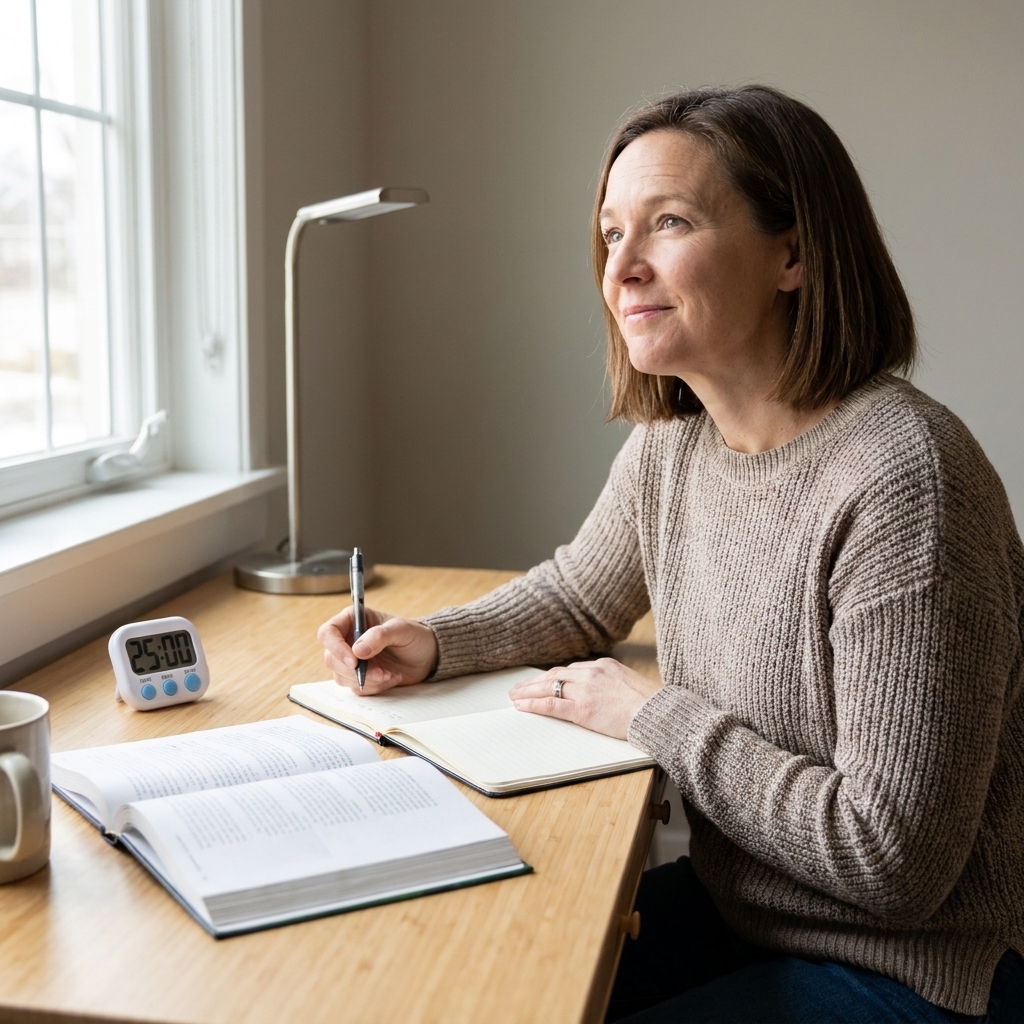
I used to think my restlessness meant I was bad at studying. I would sit down with the best intentions, highlight a few lines, and then suddenly I was reorganizing my desk or pacing the hallway with my notes like a caffeinated museum docent.
Here is what finally clicked for me: the movement was not the problem. The problem was pretending I could learn like a statue.
If you learn best when your body is involved, this guide gives you a realistic routine you can run on a normal day, plus a few simple ways to build memory using physical activity, tangible models, and controlled environment changes. This is a strategy, not a diagnosis. Take what works, skip what does not, and adjust to your space and body.
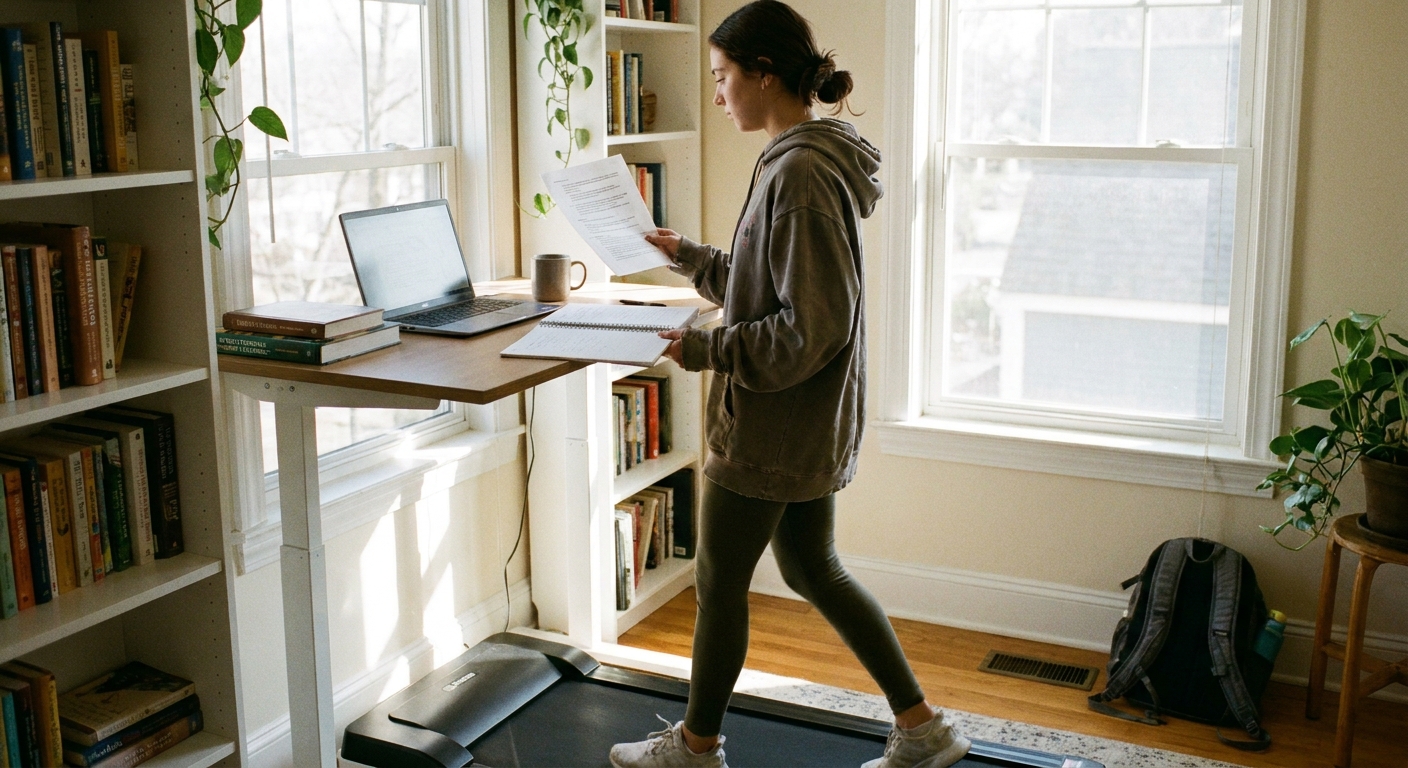
What counts as kinesthetic studying
Kinesthetic studying is not just “hands-on” in the craft sense. It is learning that often feels easier when you add one or more of these:
- Movement: walking, standing, pacing, stretching, shifting positions
- Touch: manipulating objects, writing by hand, building models, sorting cards
- Action: practicing steps, role-playing, teaching aloud while moving
- Environment change: rotating locations to refresh attention and reduce mental fatigue for some people
This is not about being unable to focus. It is about choosing a study setup that matches your attention system instead of fighting it. If you want a quick gut-check that your current plan is mismatched, skim 7 signs your study plan clashes with your learning style.
The core routine: Move, Build, Switch, Retrieve
I like a simple loop you can repeat for one subject or an entire study block:
- Move to get attention online
- Build a physical anchor for the concept
- Switch the environment to reduce fade-out
- Retrieve from memory (the part that creates durable learning)
Below is the step-by-step version with times you can actually follow.
Step 1: Set up a “study path” (5 minutes)
Before you start, create a mini route for your session. You are not trying to add chaos. You are trying to plan your movement so it supports learning.
Your three-zone setup
- Zone A: Input station (sit) for reading and watching. Desk, table, or couch.
- Zone B: Movement lane (stand or walk) for recall and explaining. Hallway, living room loop, backyard, or standing desk.
- Zone C: Build station (hands-on) for mapping, cards, modeling, or whiteboard work.
Keep your tools in a small basket you can carry between zones: timer, pen, index cards, a highlighter, tape or sticky notes, and one notebook.
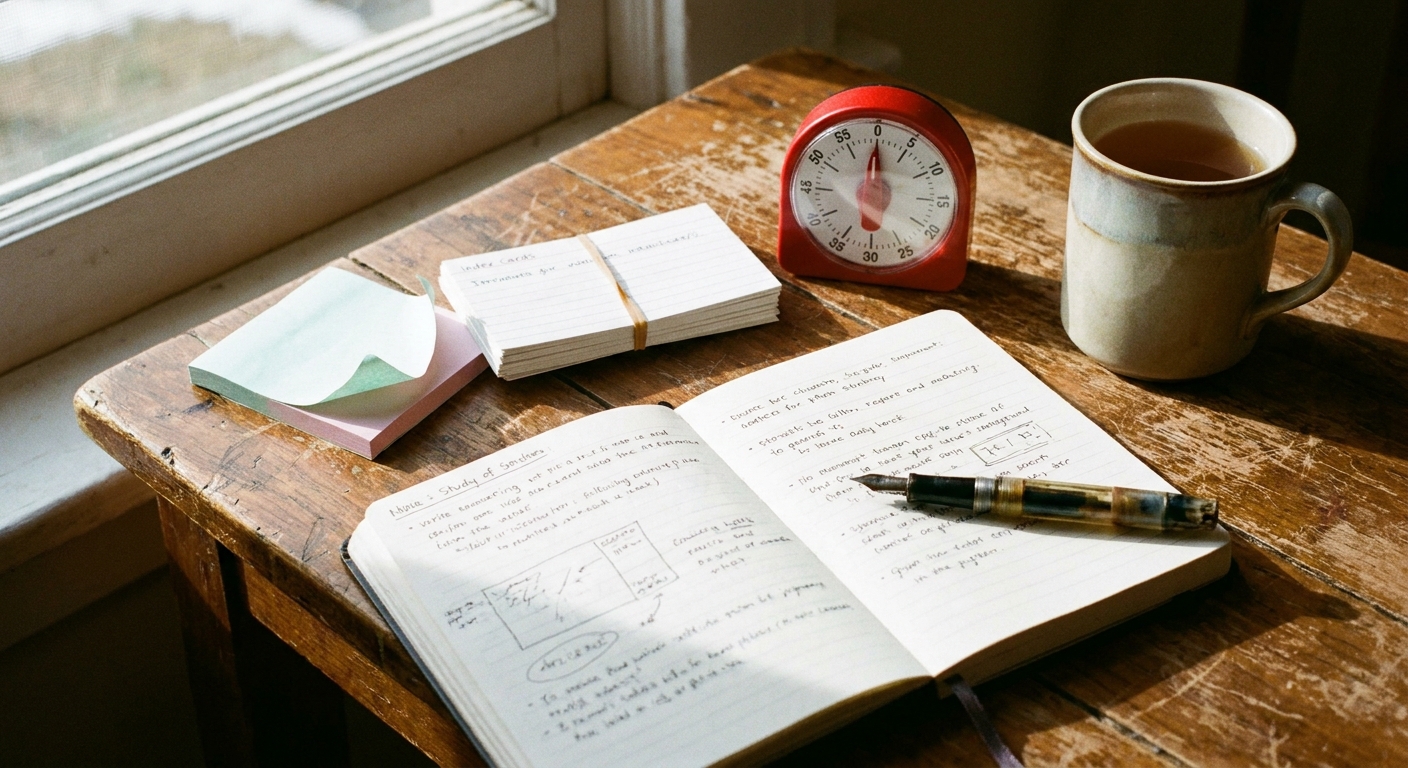
Step 2: Do a 2-minute warm-up
This is the kinesthetic equivalent of opening the right browser tabs. Pick one:
- Walk up and down your hall while taking 10 slow breaths
- Do 20 bodyweight squats or wall push-ups
- Do calf raises and shoulder rolls while you skim today’s goals
Keep it gentle. The goal is alertness, not exhaustion.
Step 3: Input sprint (12 to 15 minutes)
Start in Zone A. Choose a small slice of material you can actually finish.
Rules for the input sprint
- Set one objective: “Understand the steps of glycolysis” or “Learn 15 terms,” not “Study chapter 7.”
- Touch the content: annotate by hand, trace a process with your finger, or rewrite a definition in your own words.
- Stop early: end while you still have energy. We are about to convert input into memory.
If you like structured intervals, you can pair this with our Pomodoro by learning style guide, but do not feel locked into 25 minutes. If movement helps you focus, shorter cycles and more frequent transitions may work better.
Step 4: Build a tangible model (8 to 10 minutes)
This is where “movement and memory” becomes real. Your job is to create a physical anchor for the idea. Pick one method and reuse it until it becomes automatic.
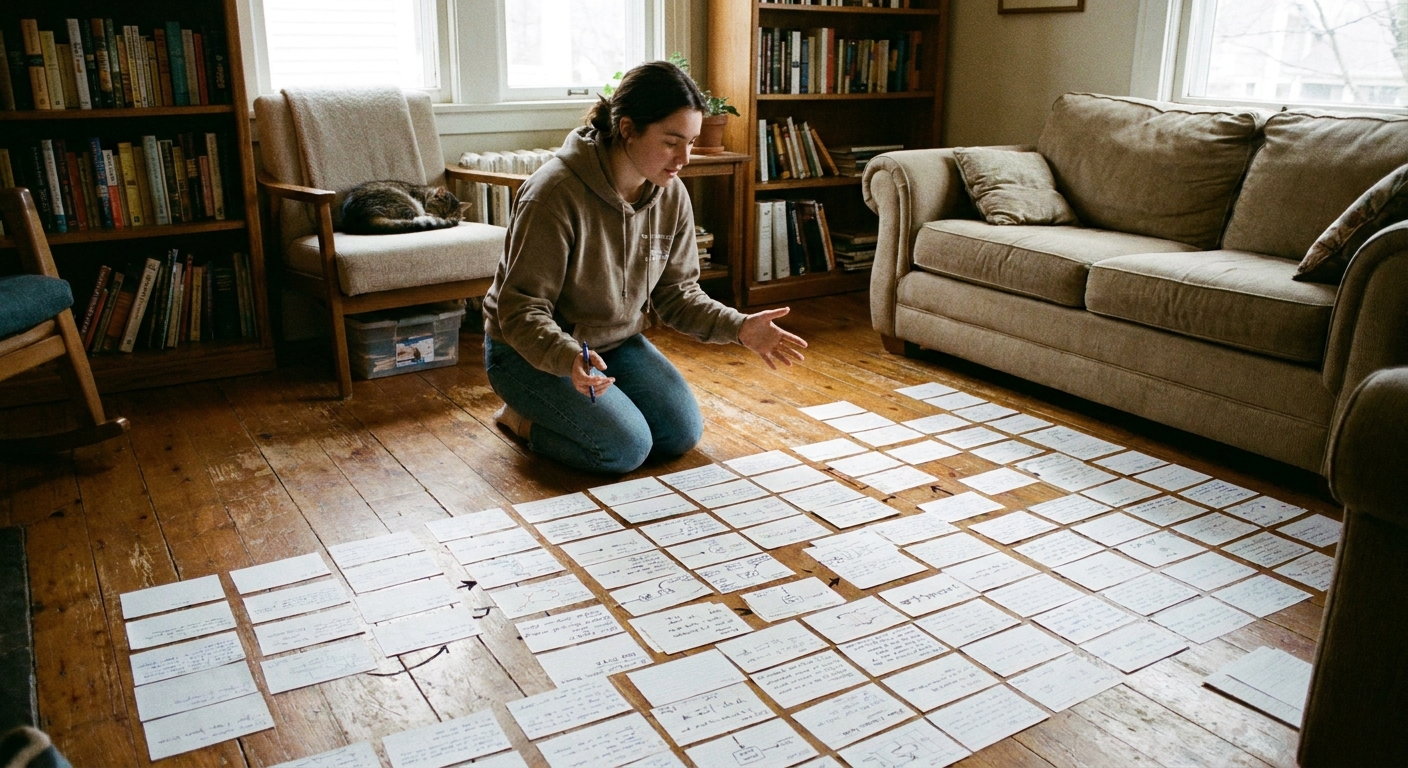
Option A: Index-card sequencing (best for processes)
- Write one step per card.
- Stand up and lay the cards on the floor or a table.
- Walk the sequence and say each step out loud.
- Shuffle and rebuild from memory.
Option B: Object mapping (best for systems)
Grab 5 to 10 small objects: coins, paper clips, blocks, LEGO pieces, or bottle caps.
- Assign each object a role (for example: organelles, historical figures, parts of an engine).
- Move them to show relationships: cause and effect, inputs and outputs, hierarchy.
- Take a quick photo at the end so you can recreate it later.
Option C: Tape-on-the-wall recall (best for vocabulary)
- Tape terms (front) and definitions (back) to a wall at eye level.
- Walk the wall like a gallery.
- Touch the card, answer, then flip to check.
Want more quick movement ideas that fit between tasks? I keep a running list in 10 kinesthetic learning activities for homework breaks.
Step 5: Switch locations (3 minutes)
Environment switches work best when you treat them like a reset button, not an invitation to drift into errands.
My simple rule
Switch locations after you build something physical. The model you just made becomes your bridge into the next phase.
- Move from desk to standing counter
- Move from bedroom to kitchen table
- Move from indoors to porch
- Even turning your chair to face a different direction can help if space is tight
Bring only what you need for the next 10 minutes. Less stuff means fewer distractions.
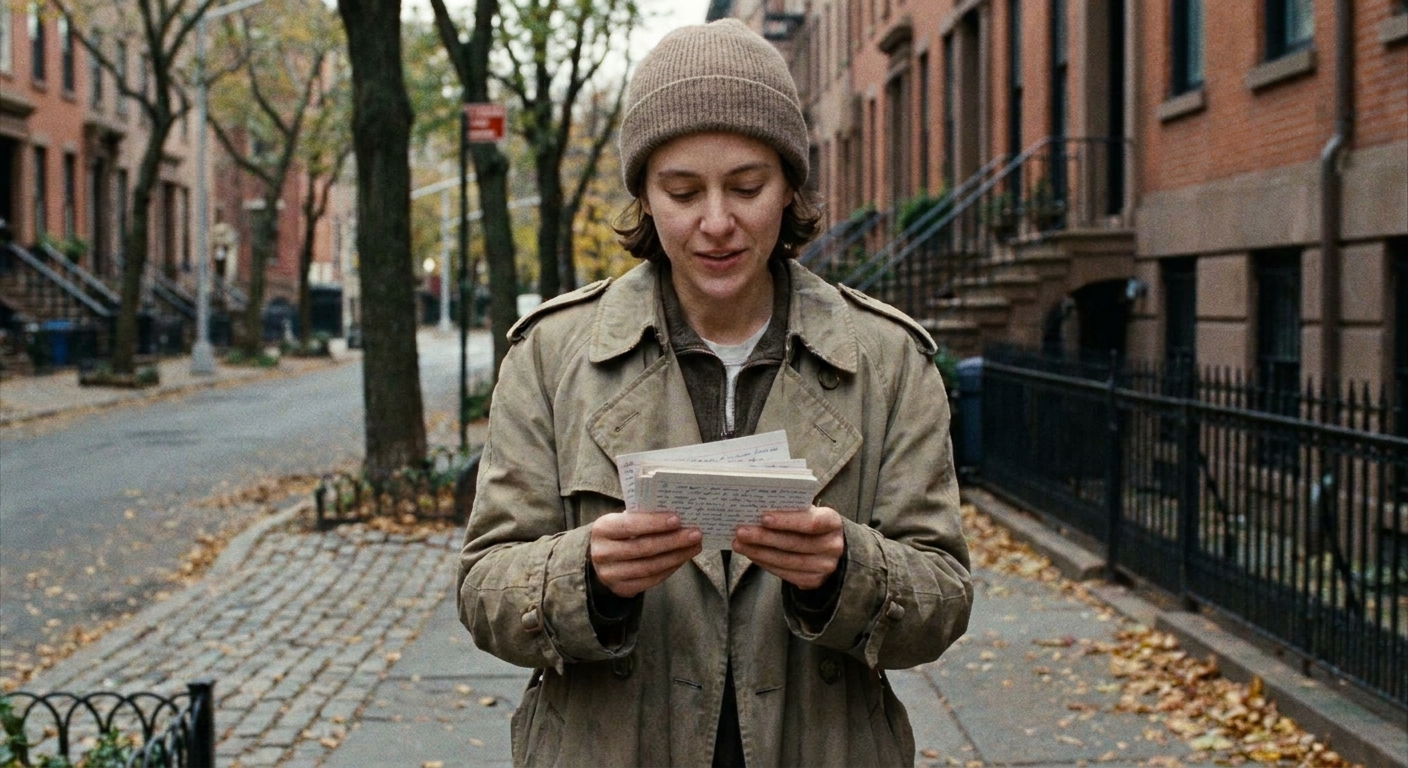
Step 6: Retrieval walk (8 to 12 minutes)
This is the memory-maker: recalling without looking. If you feel trapped sitting still, pairing retrieval with walking or standing can make it easier to stay with the task.
How to do it
- Go to Zone B (movement lane).
- Walk slowly or stand and shift your weight.
- Explain the concept out loud as if you are teaching a friend.
- When you get stuck, mark the gap in your notebook with a quick symbol (like a star) instead of stopping to reread immediately.
- After the walk, go back and patch only the starred gaps.
Safety note: keep the pace slow, and choose a clear path. Skip stairs, traffic, and anything you could trip over. I also save dense reading for sitting and use walking mainly for recall.
If you want a structured way to do the “teach it back” part, use our learning-style adaptation of the Feynman Technique for visual, auditory, and tactile learners. It is a great match for movement-based recall.
Step 7: Mini test, then stop (5 minutes)
People who study best with movement often overstudy because stopping can feel like unfinished motion. Give yourself a clean finish line.
Pick one mini test
- Blank page: write everything you remember for 3 minutes, then check.
- Three questions: create three test-style questions and answer them without notes.
- One-sentence summary: write the concept in one sentence, then expand to three sentences.
Then stop. If you want to plan the next session, write a single next step: “Tomorrow: rebuild the card sequence without looking.”
For deeper testing strategies that still feel practical, see practice tests that improve your study plan.
A 45-minute study block
If decision fatigue is your enemy, copy this exactly for a week:
- 0:00 to 0:02 warm-up movement
- 0:02 to 0:15 input sprint (read, watch, or listen while annotating)
- 0:15 to 0:25 build a tangible model (cards, objects, wall terms)
- 0:25 to 0:28 location switch
- 0:28 to 0:40 retrieval walk (teach it out loud)
- 0:40 to 0:45 mini test and next-step note
Need something even shorter for a busy day? This pairs nicely with 15-minute microlearning at work. The same loop works in miniature.
Make it stick with spacing
One good session helps. Repeating short sessions across days is what usually locks it in.
A simple weekly rhythm
- Day 1: build model plus retrieval walk
- Day 2: rebuild model from memory plus quick quiz
- Day 4: retrieval walk only plus practice questions
- Day 7: mixed review in a new location
If you want a more structured approach to spacing that still respects learning style differences, start with spaced repetition by learning style.
If movement becomes distraction
If you keep wandering into chores
- Define a physical boundary: “I only walk between the couch and the hallway rug.”
- Carry a single item: just your cards or just your notebook, not your whole bag.
- Use a timer that you can hear from the next room.
If you get sweaty or overstimulated
- Slow the movement down: gentle pacing beats jumping jacks for most study tasks.
- Swap cardio for pressure: sit on the floor, lean against a wall, or use a firm pillow in your lap.
- Drink water before you start. Dehydration can feel like “I cannot focus.”
If you feel silly talking out loud
- Start with whisper-teaching.
- Record a voice memo while walking and listen back later on a commute.
- Pretend you are leaving someone a helpful voicemail. It lowers the performance pressure.
If staying on task is the main struggle, layer in shorter focus games and reset moments from focus-building games for homework attention and the break structure in strategic study breaks.
Accessibility options
If walking or standing is not comfortable, you can still use this approach. Keep the loop, just scale the movement down.
- Micro-movements: ankle circles, shoulder rolls, gentle seated shifting, or changing leg position on a timer.
- Hand-based movement: finger-tracing diagrams, sorting cards on a tray, or moving small objects to model relationships at your desk.
- Location “switches” without distance: rotate your chair, change lighting, or move from desk to bed with the same materials.
Quick add-ons
You do not need all of these. Pick one add-on, run it for a week, then decide.
1) Standing summaries
Every time you finish a page, stand up and summarize it in 20 seconds. Sitting back down is the reward.
2) Whiteboard or window writing
Writing large often helps you chunk information. If you do not have a whiteboard, a dry-erase marker on a glass window (test a corner first) can work.
3) Two-location review
Learn in one place, retrieve in another. The point is not novelty. It is separating input from recall.
4) Role-play for soft skills
If your subject involves communication, conflict, teaching, interviewing, or leadership, role-play can be a superpower. Try the activities in stress-free test prep role-play activities even if your “test” is a presentation or evaluation.
FAQ
Is it okay to study while walking?
Yes, especially for retrieval: explaining, reciting, quizzing yourself, and reviewing flashcards. For heavy input like dense reading, many people do better seated first, then walking for recall.
What if I have to study in a quiet place like a library?
Use silent movement: stand at a high counter, shift weight, do calf raises, or take short aisle walks between sections. You can also do retrieval in your head and write brief bullet points when you return to your seat.
Does changing environments help memory?
It can help attention and reduce mental fatigue for some people, which indirectly supports memory. The bigger win comes from what you do after the switch: retrieval, practice questions, and rebuilding your model.
I feel like I need movement every two minutes. Am I doing it wrong?
Not necessarily. Start with shorter cycles: 8 minutes input, 5 minutes build, 5 minutes retrieval. Then slowly stretch the input portion once the routine feels safe and predictable.
Your next session
If you want the shortest possible starting point, do this once today:
- Read for 12 minutes while annotating by hand.
- Build one physical model (cards or objects) for 8 minutes.
- Walk and teach it out loud for 10 minutes.
- Write a 3-minute blank-page recall.
That is enough. Studying with movement is not about doing more. It is about letting your body help your brain do the job it is already trying to do.