

Flashcards have their place, but if you have a tactile learner in front of you, they can feel like asking a kid to learn soccer by staring at a rulebook. I love math, but I did not always love math practice. The turning point for me was realizing that drills do not have to be still.
These seven activities keep the “practice” part, but swap out the flat, repetitive format for something kids can touch, move, build, and reset. Most of these can be set up in about five minutes (and the ones that take longer usually involve tape on the floor).
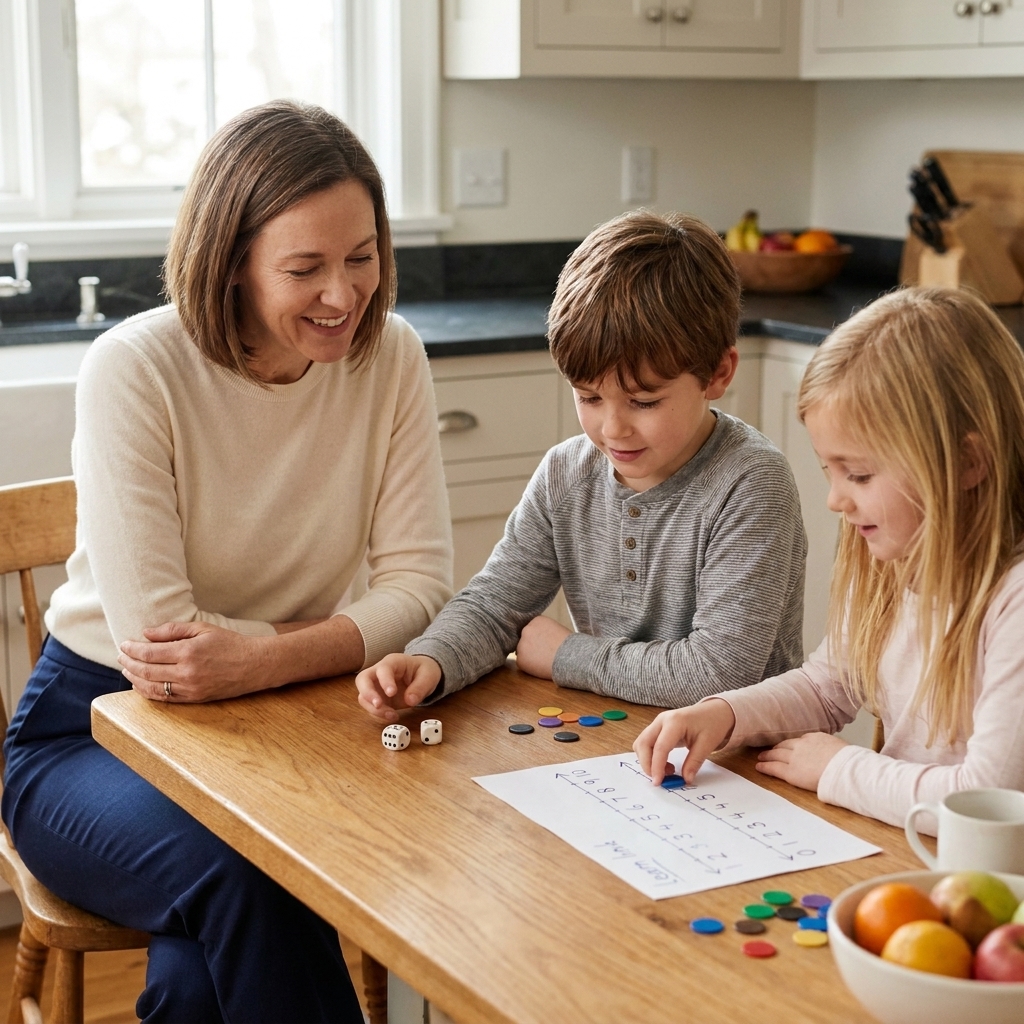
Before you start: make it a game
To keep these activities fun and effective, I use three simple rules.
- Short rounds win. Aim for 3 to 8 minutes. Stop while it still feels doable.
- One skill per game. If the goal is addition within 20, do not sneak in three-step word problems mid-round.
- Use “mistake-friendly” scoring. Points for effort, streaks, or “personal best” time are often better than only rewarding perfection.
If your child is motivation-sensitive, pairing these with tiny timed sessions can help. I use Pomodoros for older kids and even for myself, just scaled down. (If you want a flexible structure, see Pomodoro by learning style.)
One more practical note: match the game to what they are learning right now. Staying close to their current unit helps practice feel doable instead of random.
1) Dice Dash (facts practice)
This is the simplest “roll and solve” game I know, and it is endlessly adjustable.
What you need
- Two dice (or one die for younger kids)
- Paper and pencil, or a small whiteboard
How to play
- Roll two dice.
- Use the numbers to make one math fact.
- Addition: roll 6 and 3, do 6 + 3.
- Subtraction: roll 6 and 2, do 6 - 2 (use the larger number first).
- Multiplication: roll 4 and 5, do 4 × 5.
- Say the full math sentence out loud: “6 + 3 = 9.”
- Repeat for a short round: 10 rolls, or 3 minutes.
Make it hands-on
- Use counters. If they roll 8 and 5, physically build 8 counters and 5 counters, then push them together to count the total.
- Turn it into a sprint. Each correct answer earns a token. Try to beat yesterday’s token count.
Level up
- Use three dice and choose two numbers to operate with, then explain why you chose them.
- For multiplication, roll one die for the “group size” and one for the “number of groups,” then build groups with blocks.
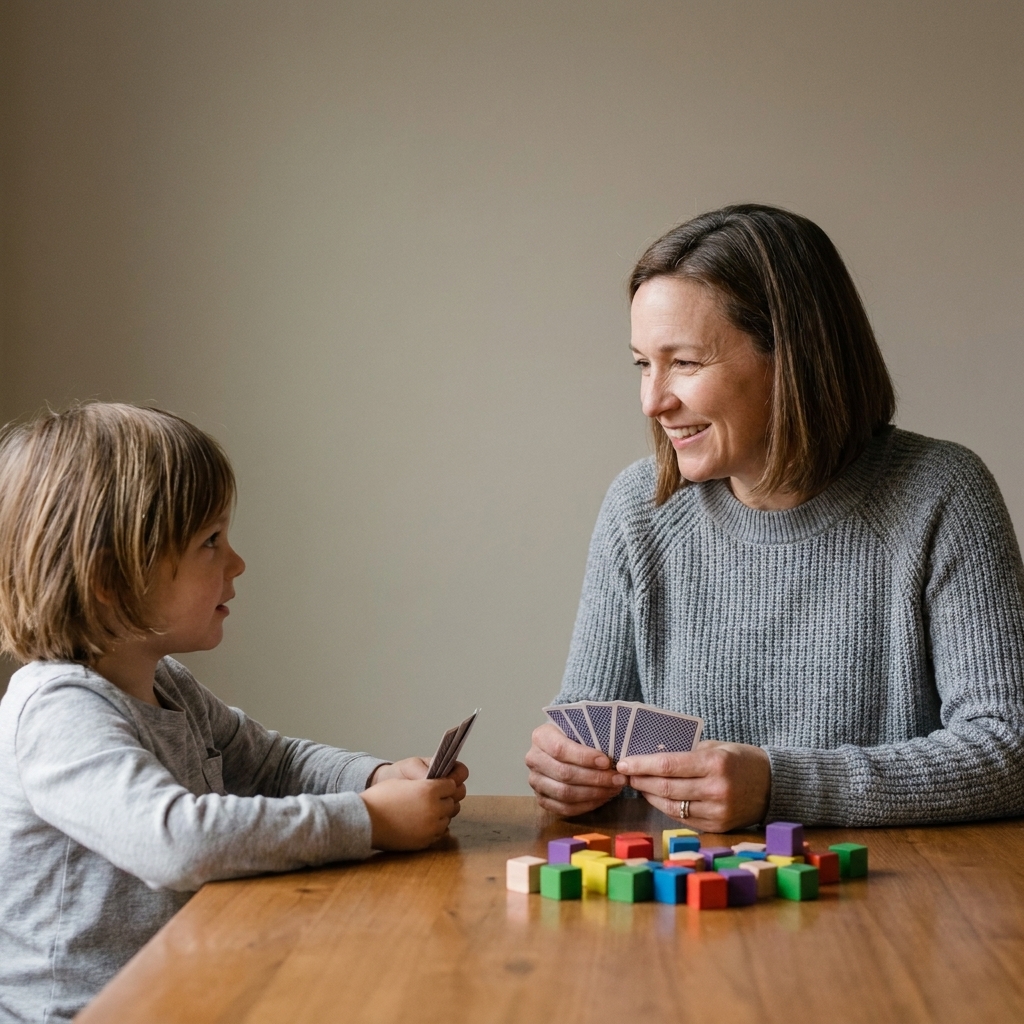
2) Card Battle Math (no worksheets)
If you already own a deck of cards, you own a math lab.
What you need
- A standard deck of playing cards
- Optional: small counters for scoring
Quick setup
- For younger kids, remove face cards.
- Or assign values: J = 11, Q = 12, K = 13, and decide A = 1 (my pick for elementary facts).
How to play (two easy versions)
- Add Battle: Each player flips two cards. Add them. Highest sum wins the round.
- Multiply Battle: Each player flips two cards. Multiply. Highest product wins.
Make it more tactile
- Winner takes a counter and stacks them. The growing stack is the scoreboard.
- For younger kids, build the sum with blocks before saying the answer.
Gentle twist for anxiety
Play cooperative: you and your child are a team trying to reach 50 points in 10 rounds. This keeps the “game” feeling even when a fact is hard.
3) Block Towers (place value)
Place value is abstract until you can literally hold it.
What you need
- Building blocks, linking cubes, LEGO bricks, or even stacks of pennies
- Sticky notes or index cards
How to play
- Declare the “unit”: one block = 1.
- Build a ten tower: 10 single blocks stacked or linked together.
- Build a number (start with two-digit numbers): for 34, build three ten towers and four singles.
- Write the expanded form: 34 = 30 + 4.
Make it a game
- Race the clock: “Can we build 57 in under 45 seconds?”
- Mystery number: You build a number behind a book. Give clues like “5 tens and 2 ones.” They guess, then you reveal.
Level up
- Trade game: every time you reach 10 ones, you must trade for 1 ten tower. This naturally teaches regrouping.
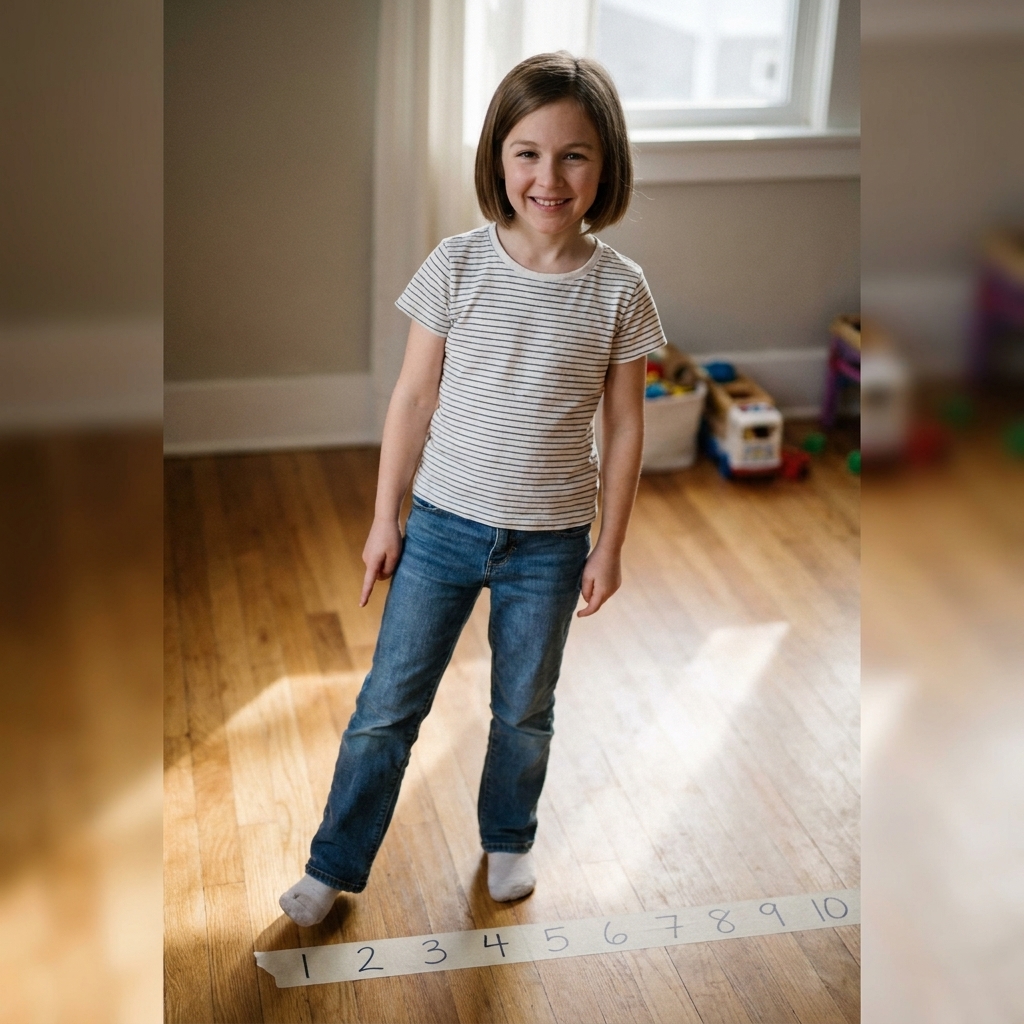
4) Number Line Hop (move + think)
This one is great for kids who learn with their whole body.
What you need
- Masking tape (or paper plates)
- Paper and marker
How to set it up
- Create a line of numbers on the floor, such as 0 to 20.
- Stand on a starting number.
How to play
- Call out a problem: “Start at 7. Jump +5.”
- They hop the jumps and say the landing number.
- Switch roles: your child calls the moves, you hop.
Safety and space
Clear the floor first and do it barefoot or in grippy socks. If your child gets overexcited, make “quiet feet” part of the rules.
Variations
- Subtraction: “Start at 14. Jump back 6.”
- Skip-counting: Hop by 2s, 5s, or 10s.
- Decimals: Use 0 to 1 in tenths and practice 0.3 + 0.2.
- Fractions: Use 0, 1/2, 1, then try “Start at 1/2. Jump + 1/2.”
5) Fact Fishing (grab and solve)
If flashcards cause groans, turn them into a physical “catch” game.
What you need
- Index cards or paper slips
- A bowl or small box
- Optional: clothespin or tongs for extra tactile input
How to play
- Write math facts on slips (example: 9 + 7, 12 - 5, 6 × 4).
- Drop them into a bowl.
- Your child “fishes” one out using fingers, tongs, or a clothespin.
- If they answer correctly, they keep it. If not, it goes back in the bowl.
Why it works
The same facts come back around, so your child gets repeated retrieval without a worksheet vibe. If you want to make it closer to true spaced repetition, sort slips into two or three cups (for example: “new,” “getting it,” “solid”) and only re-fish the “solid” cup every few days. If you want to go deeper, I have a guide on spaced repetition by learning style.
Make it gentler
Let them use a “hint card” once per round, like a number line strip or a times table pattern they are learning.
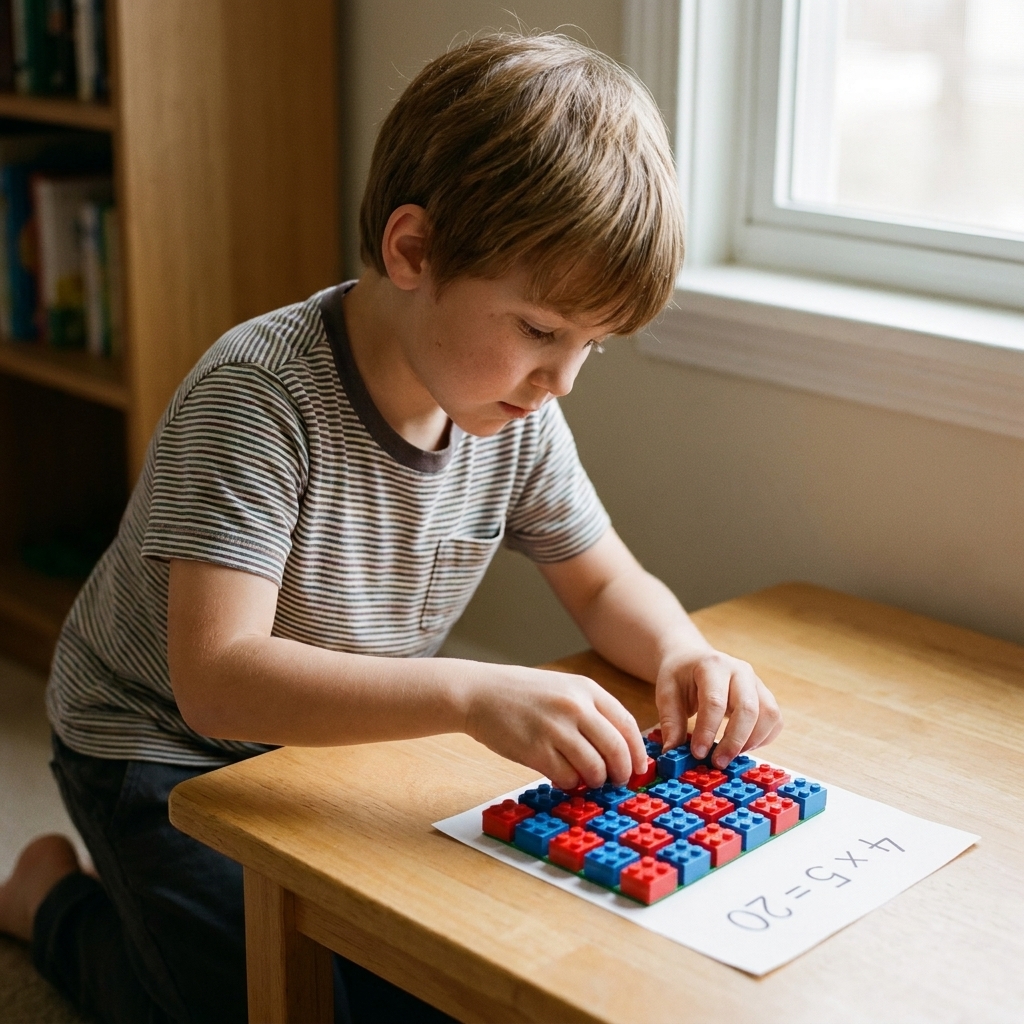
6) Build-the-Answer (arrays)
Multiplication can click faster when kids can see it as rows and columns instead of a chant.
What you need
- Blocks, LEGO bricks, tiles, coins, or beans
- Paper to record the equation
How to play
- Call out a multiplication fact: “Build 4 × 6.”
- They build an array with 4 rows of 6.
- They count by rows: 6, 12, 18, 24.
- Write it down: 4 × 6 = 24.
Quick upgrades
- Area tie-in: Trace the array on paper and talk about area as “how many squares cover it.”
- Commutative property: Flip it. “Now build 6 × 4. What changed? What stayed the same?”
7) Real-life math missions
This is the stealthiest form of practice: tiny math challenges baked into routines you already have.
Choose one mission a day
- Snack sorter: “We have 18 grapes. Can you make 3 equal groups? How many per group?”
- Stair skip-count: Count by 2s or 5s up the stairs.
- Laundry pairs: Count socks by 2s. “How many socks is 6 pairs?”
- Cooking doubles: “We need 1/2 cup. What is double? What is half of 1 cup?”
- Budget buddy: Give a small cash budget. “You can choose two items that total under $5.”
Keep it light
I treat these like mini side quests, not pop quizzes. If a mission is too hard, I model one example and we move on. Consistency beats intensity.
If you like the “small and frequent” approach, you may also enjoy the idea behind 15-minute microlearning, just adapted for kids and home routines.
Pick the right game
If you are not sure where to start, match the activity to the kind of friction you see.
- They wiggle and wander: start with Number Line Hop or Real-Life Math Missions.
- They like building and fiddling: do Block Towers or Build-the-Answer arrays.
- They crave competition or quick wins: try Dice Dash or Card Battle Math.
- They shut down around “tests”: use cooperative scoring and Fact Fishing repetition.
And if you notice strong sensory preferences, adjust the input. Sensory seekers often love bigger movement (hopping, stacking, racing). Sensory avoiders may prefer contained hands-on work (towers, arrays, fishing with tongs) at a calmer pace.
If you are exploring learning preferences more broadly, our learning styles guide can help you spot patterns without putting your child into a rigid box.
Troubleshooting
“They are rushing and guessing.”
Slow the scoring down. Award points for explaining the steps, not just the final number. You can also switch to building the answer with counters before saying it.
“They melt down when they miss.”
Use a two-try rule: first try alone, second try with a hint (number line, counters, or you talking through one step). Missing is information, not a verdict.
“They only want to play, not write anything.”
That is fine at first. When you are ready to bridge to paper, ask for one quick “receipt” at the end: write two equations they solved during the game.
“We keep starting strong and then dropping it.”
Anchor it to an existing routine. One round after snack, one round before screen time, or a quick game while dinner finishes. Habit beats willpower. If you want a simple structure for consistency, I like the checklist approach in Build a study session you can check and you can easily adapt it for daily math play.
A simple weekly rotation
If decision fatigue hits you, here is an easy rotation that keeps variety high and setup low.
- Monday: Dice Dash (facts)
- Tuesday: Block Towers (place value)
- Wednesday: Number Line Hop (add or subtract)
- Thursday: Card Battle Math (review)
- Friday: Build-the-Answer arrays (multiply or area)
- Weekend: Real-Life Math Mission (cooking, shopping, or chores)
And on any day when everyone is tired, Fact Fishing is my fallback because it is calm, contained, and still effective.
Bottom line
You do not have to choose between “fun” and “enough practice.” When kids can touch the numbers, move them, and build them, math facts stop being random trivia and start feeling like tools they can actually use.
Pick one activity from this list, run it for five minutes, and call it a win. You can always add more later. For more kid-friendly ideas you can fold into real life, visit Learning activities for kids.